what type of movements would the pectoralis muscles allow the cat to make?

Skeleton of a domestic true cat
The beefcake of the domestic cat is similar to that of other members of the genus Felis.
Mouth [edit]
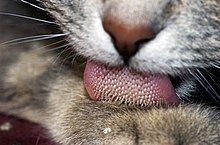
Sharp spines or papillae institute in a cat's tongue. v types of papillae tin can exist found in the dorsal aspect of the tongue: filiform, fungiform, foliate, vallate, and conical.
Permanent dentition teeth [edit]
Cats are carnivores that take highly specialized teeth. At that place are four types of permanent dentition teeth that structure the mouth: twelve incisors, four canines, ten premolars and four molars. [1] The premolar and first tooth are located on each side of the oral cavity that together are called the carnassial pair. The carnassial pair specialize in cutting food and are parallel to the jaw.[ii] The incisors located in the front end section of the lower and upper oral fissure are small, narrow, and accept a single root. They are used for grasping and biting food.[2]
Deciduous dentition teeth [edit]
A true cat also has a deciduous dentition prior to the germination of the permanent ane. This dentition emerges vii days afterward birth and it is composed of 26 teeth with slight differences. The mouth volition have smaller incisors, slender and strongly curved upper canines, vertical lower canines, and even smaller upper and lower molars.[2] Although the upper and lower molars are smaller than the ones that arise during permanent dentition, the similarities are striking.[2]
Natural language [edit]
The cat's tongue is covered in a mucous membrane and the dorsal attribute has 5 types of precipitous spines, or papillae. The 5 papillae are filiform, fungiform, foliate, vallate, and conical.[two] A cats sense of smell and sense of taste piece of work closely together, having a vomeronasal organ that allows them to use their natural language as scent tasters,[3] while its longitudinal, transverse, and vertical intrinsic muscles aid in motion.[2]
Ears [edit]
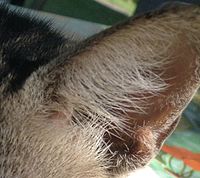
A cat's ear which has special fur for sensing and protection
Thirty-two private muscles in each ear let for a kind of directional hearing;[4] a cat can move each ear independently of the other. Considering of this mobility, a cat tin can move its trunk in i management and signal its ears in another direction. Most cats have direct ears pointing upward. Dissimilar with dogs, flap-eared breeds are extremely rare (Scottish Folds take one such exceptional mutation). When angry or frightened, a true cat will lay back its ears to back-trail the growling or hissing sounds it makes. Cats also turn their ears dorsum when they are playing or to listen to a sound coming from behind them. The fold of skin forming a pouch on the lower posterior office of the ear, known as Henry'due south pocket, is usually prominent in a cat'due south ear.[5] Its function is unknown, though it may help in filtering sounds.
Nose [edit]

A cat's olfactory organ is highly adapted
Cats are highly territorial, and secretion of odors plays a major role in true cat communication. The nose helps cats to identify territories, other cats and mates, to locate food, and has diverse other uses.[6] A true cat'south sense of odor is believed to be virtually fourteen times more sensitive than that of humans. The rhinarium (the leathery function of the nose nosotros see) is quite tough, to permit it to absorb rather rough treatment sometimes. The color varies according to the genotype (genetic makeup) of the cat. A cat's pare has the same color as the fur, but the color of the nose leather is probably dictated by a dedicated factor. Cats with white fur accept pare susceptible to harm by ultraviolet light, which may cause cancer. Extra care is required when outside in the hot lord's day.[7]
Legs [edit]

Cats are digitigrades, which means that they walk on their toes only like dogs. The reward of this is that cats (including other digitigrades) are more than active than other animals. This is because all animals usually take ground reaction forces (GRFs) at effectually two to three times their body weight per limb. Digitigrades have a higher GRF compared to other animals due to the increased weight on a smaller surface area, which would be about 6 times their torso weight per limb.[8]
Cats are as well able to walk very precisely. Developed cats walk with a "four-crush gait" meaning that each foot does not pace on the same spot as each other. Whether they walk fast or irksome, a true cat's walk is considered symmetric because the right limbs imitate the position of the left limbs as they walk. This type of locomotion provides sense of bear upon all four paws that are necessary for precise coordination.[nine]
The True cat's vertebrae are held by muscles rather than ligaments like humans.[10] This contributes to the true cat's elasticity and power to elongate and contract their back by curving it upward or oscillating it along their vertebral line.[eleven]

Cats are besides able to bound from larger heights without serious injury due to the efficient performance in their limbs and ability to control impact forces. In this case, hindlimbs are able to absorb more shock and free energy in comparison to the forelimbs, when jumping from surface to surface, as well as steer the cat for weight bearing and breaking.[12] [13]
Claws [edit]

Like nearly all members of the family Felidae, cats have protractable claws. In their normal, relaxed position, the claws are sheathed with the peel and fur around the toe pads. This keeps the claws precipitous by preventing wear from contact with the footing and allows the silent stalking of prey. The claws on the forefeet are typically sharper than those on the hind feet.[14] Cats tin can voluntarily extend their claws on one or more paws. They may extend their claws in hunting or self-defense, climbing, "kneading", or for extra traction on soft surfaces (bedspreads, thick rugs, skin, etc.). It is likewise possible to make a cooperative cat extend its claws by carefully pressing both the top and bottom of the manus. The curved claws can become entangled in carpeting or thick textile, which tin can cause injury if the cat is unable to gratis itself.
Most cats have a total of xviii digits and claws. five on each forefoot, the fifth digit being the dewclaw; and iv on each hind pes. The dewclaw is located high on the foreleg, is not in contact with the ground and is non-weight bearing.[fifteen]
Some cats tin have more eighteen digits, due to a common mutation chosen polydactyly or polydactylism,[16] which tin can effect in v to vii toes per paw.
Temperature and heart rate [edit]

Two cats sharing trunk oestrus
The normal trunk temperature of a cat is between 38.3 and 39.0 °C (100.9 and 102.2 °F).[17] A cat is considered febrile (hyperthermic) if it has a temperature of 39.5 °C (103.ane °F) or greater, or hypothermic if less than 37.5 °C (99.five °F). For comparison, humans take an average torso temperature of about 37.0 °C (98.6 °F).[18] A domestic cat's normal eye rate ranges from 140 to 220 beats per minute (bpm), and is largely dependent on how excited the cat is. For a cat at rest, the boilerplate center rate usually is between 150 and 180 bpm, more than twice that of a homo, which averages lxx bpm.[19]
Skin [edit]
Cats possess rather loose skin, which allows them to plough and face a predator or another cat in a fight, fifty-fifty when it has a grip on them. This is likewise an reward for veterinary purposes, as it simplifies injections.[20] In fact, the lives of cats with chronic kidney disease tin sometimes be extended for years past the regular injection of large volumes of fluid subcutaneously.[21] [22]
Scruff [edit]
The especially loose skin at the back of the neck is known as the scruff, and is the area past which a mother cat grips her kittens to carry them. As a result, cats tend to become repose and passive when gripped there. This behavior besides extends into adulthood, when a male person will grab the female by the scruff to immobilize her while he mounts, and to prevent her from running abroad as the mating process takes identify.[23]
This technique tin be useful when attempting to treat or move an uncooperative cat; nevertheless, since an developed true cat is heavier than a kitten, a pet true cat should never be carried past the scruff, but should instead have its weight supported at the rump and hind legs, and at the chest and front paws.[ original research? ]
Primordial pouches [edit]
Some cats share mutual traits due to heredity. One of those is the primordial pouch, sometimes referred to as "spay sway" past owners who discover it one time the cat has been spayed or neutered. It is located on a cat's belly. Its advent is similar to a loose flap of peel that might occur if the cat had been overweight and had then lost weight. It provides a little extra protection against kicks, which are common during cat fights equally a cat will try to rake with its rear claws. In wild cats, the ancestors of domesticated felines, this pouch appears to be present to provide extra room in instance the animal has the opportunity to consume a large meal and the breadbasket needs to expand. This stomach pouch also allows the cat to curve and expand, assuasive for faster running and higher jumping.[24]
Skeleton [edit]
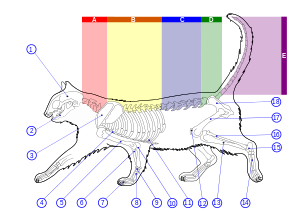
Diagram of the skeleton of a cat
- Cervical or neck bones (vii in number).
- Dorsal or thoracic bones (13 in number, each bearing a rib).
- Lumbar basic (7 in number).
- Sacral bones (three in number).
- Caudal or tail basic (xix to 21 in number).
- Cranium, or skull.
- Mandible, or lower jaw.
- Scapula, or shoulder-blade.
- Sternum, or breast-bone.
- Humerus.
- Radius.
- Phalanges of the toes.
- Metacarpal bones.
- Carpal or wrist-basic.
- Ulna.
- Ribs.
- Patella, or human knee-cap.
- Tibia.
- Metatarsal bones.
- Tarsal bones.
- Fibula.
- Femur, or thigh-bone.
- Pelvis, or hip-bone.

Cats have seven cervical vertebrae similar virtually all mammals, thirteen thoracic vertebrae (humans have twelve), seven lumbar vertebrae (humans have 5), three sacral vertebrae (humans have five considering of their bipedal posture), and, except for Manx cats and other shorter tailed cats, twenty-ii or xx-iii caudal vertebrae (humans have three to v, fused into an internal coccyx). The extra lumbar and thoracic vertebrae account for the cat'southward enhanced spinal mobility and flexibility, compared to humans. The caudal vertebrae form the tail, used past the cat as a counterbalance to the body during quick movements. Between their vertebrae, they take elastic discs, useful for cushioning the jump landings.
Unlike homo arms, cat forelimbs are attached to the shoulder by gratis-floating clavicle bones, which allows them to pass their body through any space into which they can fit their heads.[25]
Skull [edit]
The cat skull is unusual among mammals in having very large eye sockets and a powerful and specialized jaw.[26] : 35 Compared to other felines, domestic cats have narrowly spaced canine teeth, adapted to their preferred prey of minor rodents.[27]
Muscles [edit]
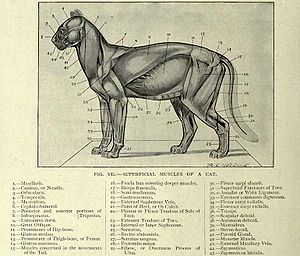
Diagram of the muscular system of a cat
Internal intestinal oblique [edit]
This muscle's origin is the lumbodorsal fascia and ribs. Its insertion is at the pubis and linea alba (via aponeurosis), and its action is the compression of abdominal contents. It besides laterally flexes and rotates the vertebral column.
Transversus abdominis [edit]
This muscle is the innermost abdominal muscle. Its origin is the second sail of the lumbodorsal fascia and the pelvic girdle and its insertion is the linea alba. Its action is the pinch of the abdomen.
Rectus abdominis [edit]
This muscle is under the all-encompassing aponeurosis situated on the ventral surface of the cat. Its fibers are extremely longitudinal, on each side of the linea alba. It is likewise traversed by the inscriptiones tendinae, or what others called myosepta.
Deltoid [edit]
The deltoid muscles prevarication only lateral to the trapezius muscles, originating from several fibers spanning the clavicle and scapula, converging to insert at the humerus. Anatomically, in that location are simply two deltoids in the cat, the acromiodeltoid and the spinodeltoid. However, to accommodate to human beefcake standards, the clavobrachialis is now also considered a deltoid and is commonly referred to as the clavodeltoid.
Acromiodeltoid [edit]
The acromiodeltoid is the shortest of the deltoid muscles. It lies lateral to (to the side of) the clavodeltoid, and in a more than husky cat it can only be seen past lifting or reflecting the clavodeltoid. Information technology originates at the acromion procedure and inserts at the deltoid ridge. When contracted, it raises and rotates the humerus outward.
Spinodeltoid [edit]
A stout and short musculus lying posterior to the acromiodeltoid. It lies forth the lower border of the scapula, and information technology passes through the upper arm, across the upper stop of muscles of the upper arm. It originates at the spine of the scapula and inserts at the deltoid ridge. Its action is to heighten and rotate the humerus outward.
Caput [edit]
Masseter [edit]
The Masseter is a great, powerful, and very thick muscle covered past a tough, shining fascia lying ventral to the zygomatic curvation, which is its origin. It inserts into the posterior half of the lateral surface of the mandible. Its activeness is the superlative of the mandible (closing of the jaw).
Temporalis [edit]
The temporalis is a peachy mass of mandibular muscle, and is too covered by a tough and shiny fascia. It lies dorsal to the zygomatic arch and fills the temporal fossa of the skull. Information technology arises from the side of the skull and inserts into the coronoid procedure of the mandible. It also, elevates the jaw.
Ocular [edit]
Cats have three eyelids. The cat's third eyelid is known every bit the nictitating membrane. It is located in the inner corner of the eye, which is also covered past conjunctiva. In healthy cats, the conjunctiva of the eyelids is not readily visible and has a pale, pink color.
Integumental [edit]
The two primary integumentary muscles of a cat are the platysma and the cutaneous maximus. The cutaneous maximus covers the dorsal region of the true cat and allows it to shake its skin. The platysma covers the neck and allows the cat to stretch the skin over the pectoralis major and deltoid muscles.
Neck and dorsum [edit]
Rhomboideus [edit]
The rhomboideus is a thick, large muscle below the trapezius muscles. It extends from the vertebral border of the scapula to the mid-dorsal line. Its origin is from the neural spines of the first 4 thoracic vertebrae, and its insertion is at the vertebral border of the scapula. Its action is to draw the scapula to the dorsal.
Rhomboideus capitis [edit]
The Rhomboideus capitis is the virtually cranial of the deeper muscles. It is underneath the clavotrapezius. Its origin is the superior nuchal line, and its insertion is at the scapula. Action draws scapula cranially.
Splenius [edit]
The Splenius is the most superficial of all the deep muscles. It is a thin, broad sheet of muscle underneath the clavotrapezius and deflecting it. It is crossed also by the rhomboideus capitis. Its origin is the mid-dorsal line of the cervix and fascia. The insertion is the superior nuchal line and atlas. It raises or turns the caput.
Serratus ventralis [edit]
The serratus ventralis is exposed past cutting the wing-like latissimus dorsi. The said muscle is covered entirely by adipose tissue. The origin is from the first nine or ten ribs and from part of the cervical vertebrae.
Serratus Dorsalis [edit]
The serratus dorsalis is medial to both the scapula and the serratus ventralis. Its origin is via apoeurosis following the length of the mid-dorsal line, and its insertion is the dorsal portion of the concluding ribs. Its action is to depress and retracts the ribs during breathing.
Intercostals [edit]
The intercostals are a set of muscles sandwiched among the ribs. They interconnect ribs, and are therefore the primary respiratory skeletal muscles. They are divided into the external and the internal subscapularis. The origin and insertion are in the ribs. The intercostals pull the ribs backwards or forrard.
Caudofemoralis [edit]
The caudofemoralis is a muscle institute in the pelvic limb.[28] The Caudofemoralis acts to flex the tail laterally to its respective side when the pelvic limb is bearing weight. When the pelvic limb is lifted off the ground, contraction of the caudofemoralis causes the limb to abduct and the shank to extend past extending the hip joint.
Pectoral [edit]
Pectoantebrachialis [edit]
Pectoantebrachialis muscle is just ane-half-inch wide and is the virtually superficial in the pectoral muscles. Its origin is the manubrium of the sternum, and its insertion is in a flat tendon on the fascia of the proximal end of the ulna. Its activity is to draw the arm towards the chest. There is no human equivalent.
Pectoralis major [edit]
The pectoralis major, also called pectoralis superficialis, is a broad triangular portion of the pectoralis muscle which is immediately beneath the pectoantebrachialis. It is smaller than the pectoralis minor musculus. Its origin is the sternum and median ventral raphe, and its insertion is at the humerus. Its activeness is to depict the arm towards the chest.
Pectoralis minor [edit]
The pectoralis minor muscle is larger than the pectoralis major. Even so, most of its inductive edge is covered by the pectoralis major. Its origins are ribs iii–five, and its insertion is the coracoid process of the scapula. Its actions are the tipping of the scapula and the elevation of ribs three–five.
Xiphihumeralis [edit]
The most posterior, flat, thin, and long strip of pectoral musculus is the xiphihumeralis. It is a band of parallel fibers that is found in felines but non in humans. Its origin is the xiphoid process of the sternum. The insertion is the humerus.
Trapezius [edit]
In the cat in that location are three thin flat muscles that cover the back, and to a lesser extent, the cervix. They pull the scapula toward the mid-dorsal line, anteriorly, and posteriorly.
Clavotrapezius [edit]
The most anterior of the trapezius muscles, information technology is also the largest. Its fibers run obliquely to the ventral surface. Its origin is the superior nuchal line and median dorsal line and its insertion is the clavicle. Its activity is to draw the clavicle dorsally and towards the head.
Acromiotrapezius [edit]
Acromiotrapezius is the middle trapezius muscle. It covers the dorsal and lateral surfaces of the scapula. Its origin is the neural spines of the cervical vertebrae and its insertion is in the metacromion procedure and fascia of the clavotrapezius. Its activeness is to draw the scapula to the dorsal, and concur the two scapula together.
Spinotrapezius [edit]
Spinotrapezius, besides chosen thoracic trapezius, is the most posterior of the three. It is triangular shaped. Posterior to the acromiotrapezius and overlaps latissimus dorsi on the front end. Its origin is the neural spines of the thoracic vertebrae and its insertion is the scapular fascia. Its activeness is to depict the scapula to the dorsal and caudal region.
Digestive system [edit]
The digestion arrangement of cats begins with their sharp teeth and abrasive tongue papillae, which aid them tear meat, which is well-nigh, if non all, of their diet. Cats naturally do not have a nutrition high in carbohydrates, and therefore, their saliva doesn't contain the enzyme amylase.[29] Food moves from the oral cavity through the esophagus and into the stomach. The gastrointestinal tract of domestic cats contains a pocket-sized cecum and unsacculated colon.[xxx] The cecum while similar to dogs, doesn't have a coiled cecum.
The stomach of the cat tin can be divided into distinct regions of motor activity. The proximal finish of the stomach relaxes when food is digested.[30] While food is being digested this portion of the stomach either has rapid stationary contractions or a sustained tonic contraction of muscle.[30] These different deportment event in either the food beingness moved around or the food moving towards the distal portion of the stomach.[30] The distal portion of the tum undergoes rhythmic cycles of partial depolarization.[29] This depolarization sensitizes muscle cells and then they are more likely to contract. The tummy is not merely a muscular structure, information technology also serves a chemical part by releasing hydrochloric acrid and other digestive enzymes to break downwards food.
Food moves from the stomach into the small intestine. The first part of the pocket-sized intestine is the duodenum. As food moves through the duodenum, it mixes with bile, a fluid that neutralizes stomach acid and emulsifies fat. The pancreas releases enzymes that aid in digestion and so that nutrients can be broken down and pass through the intestinal mucosa into the blood and travel to the rest of the body.[xxx] The pancreas doesn't produce starch processing enzymes because cats don't eat a diet high in carbohydrates.[29] Since the cat digests depression amounts of glucose, the pancreas uses amino acids to trigger insulin release instead.
Food and so moves on to the jejunum. This is the most nutrient absorbent section of the small intestine. The liver regulates the level of nutrients absorbed into the claret system from the small intestine. From the jejunum, whatsoever food that has not been captivated is sent to the ileum which connects to the large intestine.[31] The starting time part of the large intestine is the cecum and the second portion is the colon. The big intestine reabsorbs water and forms fecal thing.
At that place are some things that the cats are not able to digest. For example, cats make clean themselves by licking their fur with their tongue, which causes them to consume a lot of fur. This causes a build-upward of fur in a cat's tummy and creates a mass of fur. This is often thrown up and is meliorate known equally a hairball.[32]
The brusk length of the digestive tract of the cat causes cats' digestive system to weigh less than other species of animals, which allows cats to be active predators.[29] While cats are well adapted to be predators they have a express power to regulate catabolic enzymes of amino acids meaning amino acids are constantly being destroyed and not captivated.[29] Therefore, cats crave a higher protein proportion in their diet than many other species. Cats are not adjusted to synthesize niacin from tryptophan and, because they are carnivores, can't convert carotene to vitamin A, so eating plants while not harmful does not provide them nutrients.
Genitalia [edit]

Female genitalia [edit]
In the female true cat, the genitalia includes the uterus, the vagina, the genital passages and teats. Together with the vulva, the vagina of the true cat is involved in mating and provides a channel for newborns during parturition, or birth. The vagina is long and wide.[33] Genital passages are the oviducts of the cat. They are short, narrow, and not very sinuous.[33]
Male person genitalia [edit]
In the male cat, the genitalia includes two gonads and the penis, which is covered with minor spines.[34] [35]
Physiology [edit]
| Body temperature | 38.six °C (101.5 °F) |
| Heart rate | 120–140 beats per minute |
| Breathing rate | xvi–40 breaths per infinitesimal |

Thermograph of various body parts of a cat
Cats are familiar and easily kept animals, and their physiology has been peculiarly well studied; it mostly resembles those of other carnivorous mammals, simply displays several unusual features probably owing to cats' descent from desert-dwelling species.[37]
Heat tolerance [edit]
Cats are able to tolerate quite high temperatures: Humans by and large kickoff to feel uncomfortable when their skin temperature passes about 38 °C (100 °F), merely cats prove no discomfort until their skin reaches around 52 °C (126 °F),[26] : 46 and can tolerate temperatures of up to 56 °C (133 °F) if they have access to water.[38]
Temperature regulation [edit]
Cats conserve heat by reducing the menses of blood to their peel and lose heat by evaporation through their mouths. Cats take minimal power to sweat, with glands located primarily in their mitt pads,[39] and pant for heat relief only at very high temperatures[xl] (merely may too pant when stressed). A cat'southward body temperature does non vary throughout the twenty-four hours; this is part of cats' full general lack of circadian rhythms and may reflect their tendency to be active both during the mean solar day and at night.[41] : i
Water conservation [edit]
Cats' carrion are comparatively dry and their urine is highly concentrated, both of which are adaptations to allow cats to retain as much h2o as possible.[37] Their kidneys are so efficient, they can survive on a diet consisting only of meat, with no additional water.[42] They can tolerate high levels of salt only in combination with freshwater to prevent dehydration.[43]
Ability to swim [edit]
While domestic cats are able to swim, they are mostly reluctant to enter water as information technology rapidly leads to exhaustion.[44]
Run into also [edit]
- True cat senses
- Natural bobtail
References [edit]
- ^ Reighard, Jacob; Jennings, H. Southward. (1901). Anatomy of the cat. New York: H. Holt and Visitor. doi:10.5962/bhl.title.54000.
- ^ a b c d e f Orsini, Paul; Hennet, Philippe (Nov 1992). "Beefcake of the Mouth and Teeth of the Cat". Veterinary Clinics of Northward America: Small Animal Do. 22 (6): 1265–1277. doi:ten.1016/s0195-5616(92)50126-7. ISSN 0195-5616. PMID 1455572.
- ^ Brown, Sarah (three March 2020). The Cat. Ivy Printing. ISBN978-1-78240-857-four.
- ^ "At Habitation: Intendance / Health: Understanding Cats". Archived from the original on ane February 2008. Retrieved 15 August 2005.
- ^ August, John (2009). Consultations in Feline Internal Medicine, Volume 6. Elsevier Health Sciences.
- ^ Syufy F. "The Nose Knows Cats' Amazing Sense of Scent". Virtually.com.
- ^ "Cat Anatomy". true cat-chitchat.pictures-of-cats.org. 9 July 2008.
- ^ Miao, Huaibin; Fu, Jun; Qian, Zhihui; Ren, Luquan; Ren, Lei (23 November 2017). "How does the canine manus pad benumb ground impacts? A multi-layer cushion system". Biology Open. half-dozen (12): 1889–1896. doi:10.1242/bio.024828. ISSN 2046-6390. PMC5769641. PMID 29170241.
- ^ Pearcey, Gregory E. P.; Zehr, E. Paul (7 August 2019). "We Are Upright-Walking Cats: Human Limbs as Sensory Antennae During Locomotion". Physiology. 34 (5): 354–364. doi:10.1152/physiol.00008.2019. ISSN 1548-9213. PMID 31389772.
- ^ Cao, Dong-Yuan; Pickar, Joel G.; Ge, Weiginq; Ianuzzi, Allyson; Khalsa, Partap Due south. (Apr 2009). "Position sensitivity of feline paraspinal muscle spindles to vertebral movement in the lumbar spine". Journal of Neurophysiology. 101 (four): 1722–1729. doi:10.1152/jn.90976.2008. ISSN 0022-3077. PMC2695637. PMID 19164108.
- ^ "Cat". Encyclopedia Britannica . Retrieved xi May 2021.
- ^ Wu, Xueqing; Pei, Baoqing; Pei, Yuyang; Wu, Nan; Zhou, Kaiyuan; Hao, Yan; Wang, Wei (18 August 2019). "Contributions of Limb Joints to Free energy Absorption during Landing in Cats". Applied Bionics and Biomechanics. 2019: ane–13. doi:10.1155/2019/3815612. PMC6721424. PMID 31531125. S2CID 202101213.
- ^ Corbee, R.J.; Maas, H.; Doornenbal, A.; Hazewinkel, H.A.W. (1 October 2014). "Forelimb and hindlimb ground reaction forces of walking cats: Assessment and comparison with walking dogs". The Veterinary Journal. 202 (1): 116–127. doi:10.1016/j.tvjl.2014.07.001. ISSN 1090-0233. PMID 25155217.
- ^ Armes, Annetta F. (22 December 1900). "Outline of Cat Lessons". The School Journal. LXI: 659. Retrieved 12 November 2007.
- ^ "Cats Claws further reading". Cat Talk 101.com. Archived from the original on 18 Oct 2016. Retrieved 16 February 2017.
- ^ Danforth, C. H. (1947). "Heredity of Polydactyly in the Cat". Journal of Heredity. 38 (iv): 107–112. doi:10.1093/oxfordjournals.jhered.a105701. PMID 20242531.
- ^ "Normal Values For Domestic dog and True cat Temperature, Blood Tests, Urine and other data in ThePetCenter.com". Archived from the original on 13 March 2005. Retrieved 1 August 2005.
- ^ Publishing, Harvard Health. "Normal Torso Temperature : Rethinking the normal human being torso temperature – Harvard Health". harvard.edu . Retrieved 23 March 2018.
- ^ Cat Health And True cat Metabolism Information For The Best True cat Care. Highlander Pet Center
- ^ "Vaccinate Your Cat at Home". Retrieved eighteen October 2006.
- ^ Pictures of Skin Problems in Cats
- ^ "How to Give Subcutaneous Fluids to a Cat". wikihow.com . Retrieved 18 October 2006.
- ^ "Scruffing your dog or cat". pets.c . Retrieved 26 February 2008.
- ^ "What Is the Primordial Pouch in Cats?". Thenest.com . Retrieved 23 March 2018.
- ^ Gillis, Rick, ed. (22 July 2002). "Cat Skeleton". Zoolab: A Website for Beast Biology. La Crosse, WI: University of Wisconsin. Archived from the original on 6 December 2006. Retrieved 7 September 2012.
- ^ a b Case, Linda P. (2003). The Cat: Its Behavior, Diet, and Health. Ames, IA: Iowa Land University Press. ISBN0-8138-0331-4.
- ^ Smith, Patricia; Tchernov, Eitan (1992). Structure, Role and Development of teeth. Freund Publishing House Ltd. p. 217. ISBN965-222-270-4.
- ^ Rosenzweig, L. J. (1990). Anatomy of the Cat: Text and Dissection Guide. Wm. C. Dark-brown Publishers Dubuque, IA. p. 110, ISBN 0697055795.
- ^ a b c d e LLC, Aquanta. "Introduction to the Digestive System of Cats". www.cathealth.com . Retrieved 23 March 2018.
- ^ a b c d e Stevens, C. Edward; Hume, Ian D. (25 November 2004). Comparative Physiology of the Vertebrate Digestive Organisation. Cambridge University Press. ISBN9780521617147 . Retrieved 23 March 2018 – via Google Books.
- ^ "True cat Digestive System is integral to the assimilation of nutrients". true cat-health-detective.com . Retrieved 23 March 2018.
- ^ "Mutual Cat Digestive Diseases". vetinfo.com . Retrieved 23 March 2018.
- ^ a b The cat's genital system and reproduction. aniwa.com
- ^ Aronson, Lester R.; Cooper, Madeline L. (1967). "Penile spines of the domestic true cat: Their endocrine‐behavior relations" (PDF). The Anatomical Record. 157 (ane): 71–78. doi:10.1002/ar.1091570111. PMID 6030760. S2CID 13070242.
- ^ Heide Schatten; Gheorghe M. Constantinescu (21 March 2008). Comparative Reproductive Biology. John Wiley & Sons. ISBN978-0-470-39025-2.
- ^ Kahn, Cynthia M.; Line, Scott (2007). Hollander, Joseph Lee (ed.). The Merck/Merial Manual for Pet Wellness. Merck & Co. ISBN978-0-911910-99-v.
- ^ a b MacDonald, Yard. L.; Rogers, Q. R.; Morris, J. Thousand. (1984). "Nutrition of the domestic cat, a mammalian carnivore". Almanac Review of Diet. four: 521–562. doi:10.1146/annurev.nu.04.070184.002513. PMID 6380542.
- ^ US National Enquiry Council Subcommittee on Canis familiaris and Cat Nutrition (2006). Nutrient Requirements of Dogs and Cats. Washington DC: National Academies of Sciences, Engineering, and Medicine. p. 292. ISBN978-0-309-08628-8.
- ^ "How practice cats sweat?". CatHealth.com. Archived from the original on three March 2014. Retrieved 24 February 2014.
- ^ Adams, T.; Morgan, Yard. 50.; Hunter, W. S.; Holmes, 1000. R. (1970). "Temperature Regulation of the Unanesthetized Cat During Balmy Cold and Severe Heat Stress". Journal of Practical Physiology. 29 (6): 852–858. doi:ten.1152/jappl.1970.29.6.852. PMID 5485356.
- ^ US National Research Council Committee on Animal Diet (1986). Nutrient Requirements of Cats (2nd ed.). Washington DC: National Academies of Sciences, Engineering, and Medicine. doi:x.17226/910. ISBN978-0-309-03682-5. Archived from the original on 15 Baronial 2010.
- ^ Prentiss, Phoebe Thou. (1959). "Hydropenia in Cat and Dog: Ability of the Cat to Run into its H2o Requirements Solely from a Diet of Fish or Meat". American Journal of Physiology. 196 (three): 625–632. doi:10.1152/ajplegacy.1959.196.3.625. PMID 13627237.
- ^ Merck Veterinarian Manual
- ^ Fraser, Andrew F. (2012). Feline Behaviour and Welfare. Center for Agriculture and Bioscience International. p. 107. ISBN978-1-78064-121-viii.
External links [edit]
- The true cat; an introduction to the written report of backboned animals, peculiarly mammals (1881)
- A laboratory guide for the dissection of the cat: An introduction to the study of anatomy (1895)
- Beefcake of the cat (1902)
Source: https://en.wikipedia.org/wiki/Cat_anatomy
0 Response to "what type of movements would the pectoralis muscles allow the cat to make?"
Post a Comment